QS Asia Rankings 2027 Latest News (November 4, 2026): The QS Asia University Rankings 2027 have revealed a mixed performance for Indian higher education institutions. While the University of Delhi (DU) has dropped out of Asia’s top 100 universities, Jawaharlal Nehru University (JNU) and Jamia Millia Islamia (JMI) have improved their positions. Meanwhile, the Indian Institute of Technology Delhi (IIT Delhi) has retained its position as India’s highest-ranked institution in Asia despite slipping seven places.
The rankings, released by QS Quacquarelli Symonds on November 3, 2026, feature 1,722 universities across 26 higher education systems in Asia. India has emerged as the second most represented location, with 325 universities, including 34 new entrants.
However, the rankings also reveal an important concern: approximately 71% of India’s previously ranked institutions have moved down compared with the preceding edition.
For students considering admission to Delhi University, JNU, Jamia Millia Islamia, Banaras Hindu University and other major Indian institutions, the latest results offer an opportunity to compare universities across academic reputation, research output, employability and international engagement.
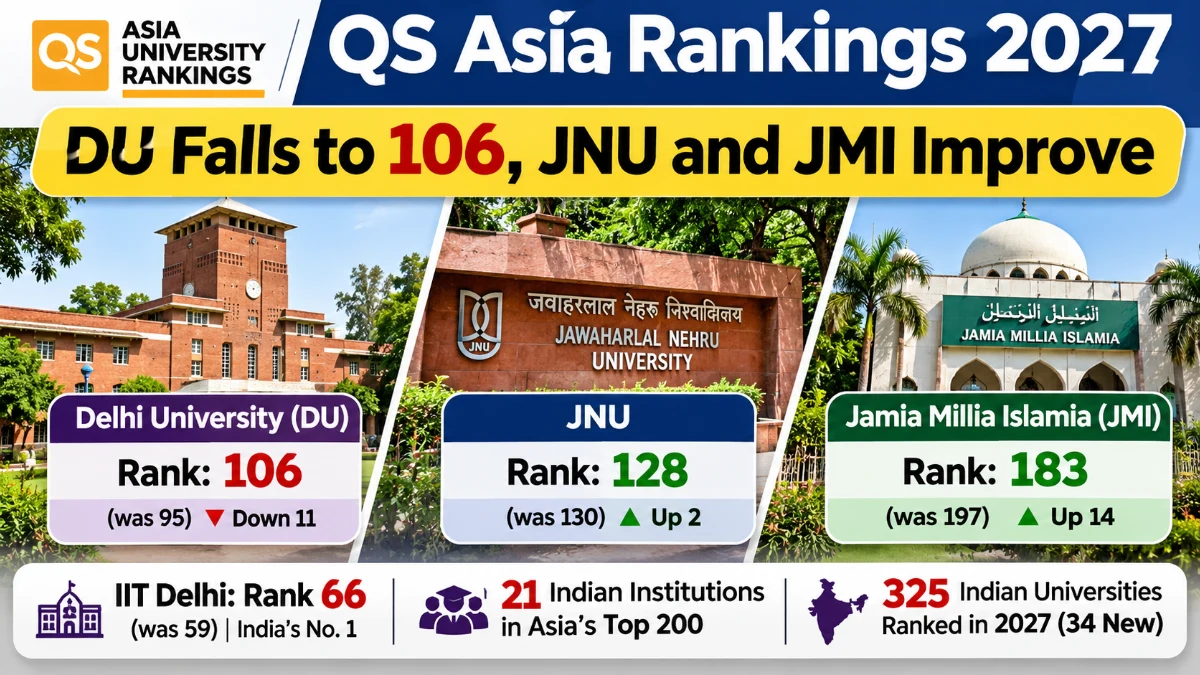
QS Asia Rankings 2027: Key Highlights
| Particulars | Details |
|---|---|
| Ranking name | QS World University Rankings: Asia 2027 |
| Released on | November 3, 2026 |
| Published by | QS Quacquarelli Symonds |
| Total Asian universities ranked | 1,722 |
| Indian universities ranked | 325 |
| New Indian entrants | 34 |
| Indian institutions in Asia’s top 200 | 21 |
| India’s highest-ranked institution | IIT Delhi - 66 |
| Delhi University rank | 106 |
| JNU rank | 128 |
| Jamia Millia Islamia rank | 183 |
| Asia’s top-ranked university | University of Hong Kong |
| Official ranking portal | topuniversities.com |
The central takeaway is that India is expanding its representation in the rankings, but many established institutions face increasingly strong regional competition.
Delhi University QS Asia Ranking 2027: DU Falls Out of Top 100
The University of Delhi, one of India’s most prominent public universities, has fallen from 95th position in the 2026 edition to 106th position in QS Asia Rankings 2027.
This represents a decline of 11 places and takes DU outside the top 100 Asian universities.
| Ranking Year | DU Asia Rank |
|---|---|
| 2026 | 95 |
| 2027 | 106 |
| Change | Down 11 places |
The development is particularly notable because Delhi University attracts large numbers of undergraduate and postgraduate applicants through competitive admission processes, including CUET.
However, a decline in regional ranking does not automatically mean that academic quality at the institution has deteriorated.
University rankings are relative comparisons. An institution may move downward when other universities improve their scores or when competition intensifies.
The latest ranking should therefore be viewed alongside DU’s academic departments, course-specific strengths, accreditation, placement information and other relevant indicators.
What Does DU’s Rank of 106 Mean for Students?
Delhi University’s position at 106 does not affect the validity of degrees awarded by the institution or automatically change its admission eligibility requirements.
Students seeking admission should continue to follow official DU admission notifications and the applicable entrance examination requirements.
A university’s overall Asia rank is useful for comparison, but it should not replace programme-specific research.
 NAAC A++
 NIRF #2 (2025)Jawaharlal Nehru UniversityNew Delhi, DelhiAdmission: CUET UG, CUET PG, NET/JRFEst. 1969View details
 NAAC A++
 NIRF #4 (2025)Jamia Millia IslamiaNew Delhi, DelhiAdmission: CUET UG, CUET PG, NET/JRFEst. 1920 · 239 acresView details
 NAAC A++
 NIRF #5 (2025)University of DelhiNew Delhi, DelhiAdmission: CUET UG, CUET PG, JEE MainEst. 1922View detailsCSU
 Central UniversityCentral Sanskrit UniversityNew Delhi, DelhiAdmission: CUET UG, CUET PG, NET/JRFEst. 1970View details
 NAAC A++
 Central UniversityIndira Gandhi National Open UniversityNew Delhi, DelhiEst. 1985View detailsSLBSN
 Central UniversityShri Lal Bahadur Shastri National Sanskrit UniversityNew Delhi, DelhiAdmission: CUET UG, CUET PG, NET/JRFEst. 1962View detailsSAU
 Central UniversitySouth Asian UniversityNew Delhi, DelhiAdmission: Own Entrance, NET/JRFEst. 2010View details
JNU QS Asia Ranking 2027: Jawaharlal Nehru University Improves
Jawaharlal Nehru University has improved its position in the QS Asia University Rankings 2027.
JNU has climbed from 130th place in 2026 to 128th position in 2027, gaining two places.
| Ranking Year | JNU Asia Rank |
|---|---|
| 2026 | 130 |
| 2027 | 128 |
| Change | Up 2 places |
Although the improvement is modest, JNU’s movement contrasts with the decline recorded by several other leading Indian institutions.
JNU is widely associated with postgraduate education, social sciences, languages, international studies and research programmes.
Its performance is especially relevant to students considering master’s degrees, doctoral research and other advanced academic programmes.
The new ranking provides another reference point for evaluating the university’s regional standing, although subject-specific QS rankings and academic department information may offer a more detailed picture.
Jamia Millia Islamia QS Asia Ranking 2027: JMI Climbs 14 Places
Jamia Millia Islamia has registered a notable improvement in the latest Asian university rankings.
The New Delhi-based central university has advanced from 197th position in 2026 to 183rd position in 2027.
This represents an improvement of 14 places.
| Ranking Year | JMI Asia Rank |
|---|---|
| 2026 | 197 |
| 2027 | 183 |
| Change | Up 14 places |
Jamia Millia Islamia remains among India’s institutions placed in the regional top 200.
The university offers undergraduate, postgraduate and research programmes across multiple disciplines, including humanities, social sciences, engineering, education and other professional fields.
For prospective students, the improvement is a positive development in JMI’s regional visibility.
However, an improvement in overall ranking should not be interpreted as confirmation that every course or department has improved by the same margin.
IIT Delhi Remains India’s No. 1 Institution in QS Asia Rankings 2027
The Indian Institute of Technology Delhi has retained the highest position among Indian institutions in the QS Asia University Rankings 2027.
IIT Delhi is ranked 66th in Asia, compared with 59th in 2026.
Despite losing seven places, it remains India’s best-performing institution in this regional ranking.
Other leading institutions have also experienced declines.
The Indian Institute of Science (IISc) Bengaluru dropped from 64th to 79th, while IIT Bombay moved from 71st to 83rd.
IIT Madras, IIT Kharagpur and IIT Kanpur also registered lower positions compared with the previous edition.
Notably, all six of India’s highest-ranked institutions have slipped in their relative Asia rankings.
QS Asia Rankings 2027: Top 21 Indian Universities and Institutions
The following table compares the positions of all 21 Indian institutions appearing among Asia’s top 200 universities in the 2027 edition.
| University / Institution | 2027 Rank | 2026 Rank | Trend |
|---|---|---|---|
| IIT Delhi | 66 | 59 | Down 7 |
| IISc Bengaluru | 79 | 64 | Down 15 |
| IIT Bombay | 83 | 71 | Down 12 |
| IIT Madras | 85 | 70 | Down 15 |
| IIT Kharagpur | 90 | 77 | Down 13 |
| IIT Kanpur | 97 | 77 | Down 20 |
| Chandigarh University | 104 | 109 | Up 5 |
| University of Delhi | 106 | 95 | Down 11 |
| IIT Guwahati | 120 | 115 | Down 5 |
| IIT Roorkee | 124 | 114 | Down 10 |
| Jawaharlal Nehru University | 128 | 130 | Up 2 |
| Lovely Professional University | 154 | 187 | Up 33 |
| VIT Vellore | 156 | 156 | Unchanged |
| BITS Pilani | 161 | 154 | Down 7 |
| O.P. Jindal Global University | 165 | 163 | Down 2 |
| Symbiosis International University | 175 | 200 | Up 25 |
| Shoolini University | 177 | 159 | Down 18 |
| Amity University | 181 | 187 | Up 6 |
| Jamia Millia Islamia | 183 | 197 | Up 14 |
| UPES | 183 | 163 | Down 20 |
| Manipal Academy of Higher Education | 195 | 206 | Up 11 |
Source: QS Asia University Rankings 2027; previous-year comparison as reported in the published results. All ranks are Asia-wide positions, not India-only ranks.
The table highlights an interesting contrast. While several established public institutions have experienced declines, institutions such as Lovely Professional University, Symbiosis International University and Jamia Millia Islamia have improved their positions.
Central Universities in QS Asia Rankings 2027: DU, JNU, JMI, BHU, AMU and Others
For students following India’s central universities, the ranking provides useful comparative information beyond the IITs and IISc.
Several prominent central universities have registered improvement, while others have declined.
| Central University | QS Asia 2027 | QS Asia 2026 |
|---|---|---|
| University of Delhi | 106 | 95 |
| Jawaharlal Nehru University | 128 | 130 |
| Jamia Millia Islamia | 183 | 197 |
| Banaras Hindu University | 234 | 224 |
| Aligarh Muslim University | 268 | 278 |
| University of Hyderabad | 270 | 246 |
| Pondicherry University | 536 | 470 |
| Tezpur University | 751-760 | 671 |
| Central University of Himachal Pradesh | 791-800 | New entrant |
| Central University of Haryana | 791-800 | 1001-1100 |
| Central University of Jammu | 801-850 | New entrant |
| North-Eastern Hill University | 901-950 | 801-850 |
Note: QS reports some lower-ranked institutions in rank bands rather than assigning every institution a single position. A band such as 791-800 does not establish an exact rank within that range.
Which Central Universities Improved?
Among the notable gainers:
- Jamia Millia Islamia improved by 14 places to 183.
- Aligarh Muslim University improved by 10 places to 268.
- Jawaharlal Nehru University improved by two places to 128.
- Central University of Haryana moved from the 1001-1100 band into the 791-800 band.
Meanwhile, the inclusion of Central University of Himachal Pradesh and Central University of Jammu as new entrants expands the representation of India’s central universities in the regional ranking.
Students should note that these figures represent overall institutional positions and do not indicate a direct comparison of individual academic departments.
Why Did So Many Indian Universities Fall in QS Asia Rankings 2027?
The most significant broader finding is that approximately seven in ten previously ranked Indian institutions moved down the Asia ranking table.
According to reported QS comparisons, 208 returning Indian institutions declined, 51 improved and 32 remained at the same rank or rank band.
These movements correspond to approximately 71%, 18% and 11%, respectively, among institutions with comparable previous-year positions.
The figures should not be interpreted as meaning Indian university education has become 71% worse.
1. Increasing Competition Across Asia
The 2027 rankings include 1,722 institutions, and the expanding field creates more competition for positions.
Universities in mainland China, Hong Kong and several other higher education systems have recorded strong performances.
As the ranking population changes, maintaining the same position can become increasingly difficult.
2. Academic and Employer Reputation
Academic reputation and employer reputation are major elements of QS’s evaluation methodology.
Universities with strong international visibility and positive employer perceptions can perform better in these indicators.
QS has identified reputation-related indicators as areas of pressure for many Indian universities.
3. International Engagement
The ranking considers international students, international faculty members, research collaboration and student exchange activity.
Limited international participation can affect performance in these categories.
4. Research Impact
Research productivity remains an important strength for India, but research influence is not identical to the total number of published papers.
A university may publish a large number of research papers without achieving equally strong citation performance.
This distinction helps explain why research output and overall ranking positions do not always move together.
Importantly, a decline in rank alone is insufficient to establish that an individual university’s academic or research performance has weakened. Institution-specific indicator data is needed for that conclusion.
India’s Research Performance: Strong Output, Uneven Citation Impact
Despite the overall decline experienced by many universities, India has demonstrated considerable strength in research productivity.
According to the ranking analysis, 27 Indian institutions are placed among Asia’s top 50 for the Papers per Faculty indicator.
Five Indian institutions feature in the top 10 for this measure:
| Institution | Asia Rank for Papers per Faculty |
|---|---|
| IISc Bengaluru | 1 |
| IIT Madras | 3 |
| IIT Delhi | 7 |
| IIT Roorkee | 8 |
| IIT Ropar | 9 |
This indicator measures research publications relative to the number of academic staff members.
India also has 15 institutions sharing the highest position in Asia for the Staff with PhD indicator.
However, only three Indian universities are among Asia’s top 50 for Citations per Paper.
This contrast suggests that India performs particularly strongly in research output, while the international influence of published research remains an important area for improvement.
QS Asia Rankings 2027: Top Universities in Asia
The University of Hong Kong has retained the top position in the QS Asia University Rankings 2027.
Peking University has maintained second place, while Tsinghua University has climbed to third position.
| Asia Rank 2027 | University | Location |
|---|---|---|
| 1 | University of Hong Kong | Hong Kong SAR |
| 2 | Peking University | Mainland China |
| 3 | Tsinghua University | Mainland China |
| 4 | City University of Hong Kong | Hong Kong SAR |
| 5 | Chinese University of Hong Kong | Hong Kong SAR |
| =6 | Fudan University | Mainland China |
| =6 | National University of Singapore | Singapore |
| 8 | Nanyang Technological University | Singapore |
| =9 | Hong Kong Polytechnic University | Hong Kong SAR |
| =9 | Hong Kong University of Science and Technology | Hong Kong SAR |
The equal sign indicates a shared ranking position.
Hong Kong has five universities in the top 10, while mainland China has three and Singapore has two.
India’s highest-ranked institution, IIT Delhi, is placed at 66th position.
How Are QS Asia University Rankings Calculated?
QS evaluates universities using 11 indicators covering academic reputation, employer reputation, research, teaching resources and international engagement.
The QS Asia ranking methodology uses the following indicator weights:
| Ranking Indicator | Weight |
|---|---|
| Academic Reputation | 30% |
| Employer Reputation | 20% |
| Faculty/Student Ratio | 10% |
| International Research Network | 10% |
| Citations per Paper | 10% |
| Papers per Faculty | 5% |
| Staff with PhD | 5% |
| International Faculty | 2.5% |
| International Students | 2.5% |
| Inbound Exchange Students | 2.5% |
| Outbound Exchange Students | 2.5% |
Academic and employer reputation together account for 50% of the overall weighting.
Research-related indicators and international engagement also contribute significantly to the final positions.
The methodology differs from the QS World University Rankings, so a university’s Asia rank should not be directly compared with its global rank.
QS Asia Rankings vs NIRF Rankings: What Should Indian Students Follow?
Students should understand that QS Asia Rankings and India’s National Institutional Ranking Framework (NIRF) are different ranking systems.
| Feature | QS Asia Rankings | NIRF Rankings |
|---|---|---|
| Ranking organisation | QS Quacquarelli Symonds | Ministry of Education, Government of India |
| Coverage | Universities across Asia | Indian institutions |
| Major emphasis | Reputation, research, internationalisation and academic indicators | Teaching, research, graduation outcomes, inclusivity and perception |
| Main purpose | Regional comparison | Domestic institutional comparison |
| Ranking result | Asia-wide position | India-specific position |
Students researching admissions should ideally consider multiple indicators rather than depending entirely on a single ranking.
For example, a student planning postgraduate research might prioritise faculty expertise, research facilities and department-level academic performance.
An undergraduate applicant may place greater emphasis on course availability, affordability, location, academic resources and admission requirements.
Neither QS nor NIRF rankings automatically determine eligibility for university admission.
What Do QS Asia Rankings 2027 Mean for Indian Students?
The latest ranking results offer both encouraging and challenging signals for Indian higher education.
India has expanded its representation in Asia’s university ranking system, with 325 institutions now included.
This provides students and researchers with a broader range of institutions to compare.
At the same time, the decline in regional positions of several established universities underlines the importance of international collaboration, academic reputation and measurable research impact.
Students should consider the following when evaluating a university:
- Overall institutional standing and subject-specific rankings.
- Recognition, accreditation and programme eligibility.
- Academic curriculum and faculty expertise.
- Research facilities and opportunities.
- Placement outcomes and career support.
- Tuition fees, scholarships and location.
A university’s rank can be one useful indicator, but choosing the right institution requires a broader assessment.
How to Check QS Asia University Rankings 2027 Online
Students can access the rankings through the official QS platform.
- Visit the QS Asia University Rankings official website.
- Select the 2027 ranking edition if prompted.
- Use the search or country filters to find a university.
- Review its regional position and available institutional details.
- Compare results with the previous edition where available.
Some additional comparison tools or indicator-level information may require a free QS account.
Official Sources and References
The figures and rankings in this report have been compiled with reference to the following sources:
- QS Official Asia 2027 Results and Analysis
- QS Asia University Rankings - Full Results
- QS Asia Ranking Methodology
- Indian Express - Indian Universities’ Performance in QS Asia 2027
Conclusion
The QS Asia Rankings 2027 present a mixed picture for India’s higher education sector.
Delhi University has slipped to 106th position and moved outside Asia’s top 100, while Jawaharlal Nehru University and Jamia Millia Islamia have improved to 128th and 183rd positions, respectively.
IIT Delhi remains India’s highest-ranked institution at 66th place, although it too has experienced a decline.
With 325 Indian universities now appearing in the rankings, the country’s participation continues to expand even as competition across Asia becomes more intense.
For prospective students, the latest ranking offers a useful comparison of institutional performance, but academic programmes, entrance requirements, affordability and career opportunities should remain central to admission decisions.
For further updates on Indian universities, admissions, entrance examinations and higher education rankings, follow CentralUniversity.in.
Last updated: November 4, 2026. This is an independent educational news report based on publicly available QS ranking information. CentralUniversity.in is not affiliated with QS Quacquarelli Symonds.