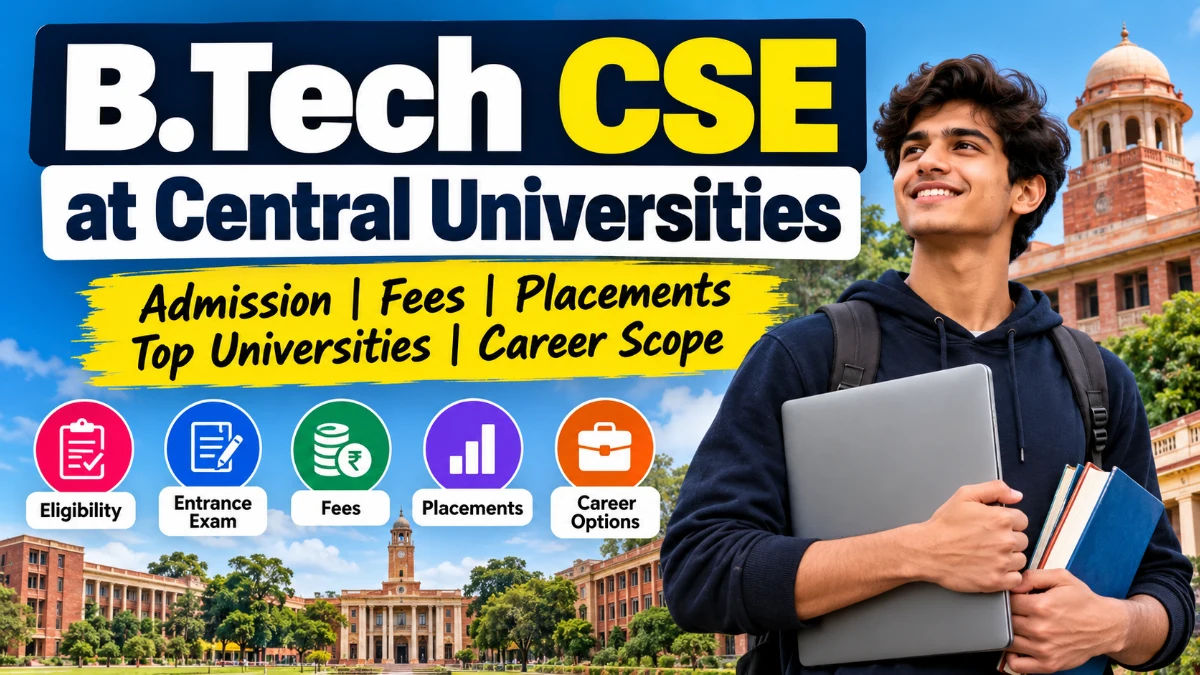
B.Tech CSE at Central Universities is an attractive option for students who want to pursue Computer Science and Engineering at a government-funded university in India. Several central universities offer four-year B.Tech programmes in Computer Science and Engineering, while others provide specialised degrees in Artificial Intelligence, Machine Learning, Data Science or integrated engineering programmes.
For the 2026–27 academic session, institutions such as the University of Delhi, Jawaharlal Nehru University, Central University of Haryana, Central University of Kashmir and Tezpur University offer B.Tech CSE programmes. Other institutions, including Jamia Millia Islamia and Central University of Karnataka, offer closely related or specialised computer engineering degrees.
Admission requirements, tuition fees, counselling procedures and placement opportunities vary significantly between institutions.
This guide explains the universities offering B.Tech CSE and related programmes, their admission processes, entrance examinations, eligibility criteria, syllabus, fees and career opportunities.
B.Tech CSE Course Highlights 2026
| Particulars | Details |
|---|---|
| Course Name | Bachelor of Technology in Computer Science and Engineering |
| Short Name | B.Tech CSE |
| Course Level | Undergraduate (UG) |
| Duration | Generally 4 years (8 semesters) |
| Main Entrance Exams | JEE Main; CUET UG for certain specialised programmes |
| Basic Eligibility | Class 12 or equivalent with required science and mathematics subjects |
| Admission Mode | JoSAA, CSAB or university-specific counselling |
| Major Subjects | Programming, DSA, DBMS, Operating Systems, Computer Networks, AI and Software Engineering |
| Higher Study Options | M.Tech, MS, MBA, PhD |
| Career Opportunities | Software Developer, Software Engineer, Data Analyst, AI/ML Engineer, Cybersecurity Analyst |
Important: The exact degree title, minimum marks, admission route and fee structure must be checked separately for each university.
Which Central Universities Offer B.Tech CSE in 2026?
Students searching for B.Tech CSE at Central Universities should distinguish between a conventional Computer Science and Engineering degree, a specialised CSE programme and an integrated engineering degree.
The following institutions have relevant programmes listed in their official university or 2026 admission information.
| Central University | Programme | Admission Route |
|---|---|---|
| University of Delhi (DU) | B.Tech Computer Science and Engineering | JEE Main 2026 + DU counselling |
| Jawaharlal Nehru University (JNU) | B.Tech Computer Science and Engineering | JEE Main through JoSAA/CSAB |
| Central University of Haryana (CUH) | B.Tech Computer Science and Engineering | JEE Main, JoSAA/CSAB and notified university counselling |
| Central University of Kashmir | B.Tech Computer Science and Engineering | JEE Main-based admission |
| Tezpur University | B.Tech Computer Science and Engineering | JEE Main; JoSAA/CSAB and Northeast quota procedures |
| Jamia Millia Islamia (JMI) | B.Tech Computer Engineering; B.Tech CSE (Data Sciences) | JEE Main + JMI admission process |
| Central University of Karnataka | B.Tech CSE (AI and ML) | CUET UG 2026 |
| Central University of Jharkhand | Integrated B.Tech–M.Tech CSE (ML and Data Science specialisation) | JEE Main-related engineering admission process |
This is a selected list of verified programmes, not a claim that these are the only central universities offering computer-related engineering degrees. Availability and programme structures should be verified for each admission year.
Best Central Universities for B.Tech CSE: University-Wise Details
1. University of Delhi (DU) – B.Tech Computer Science and Engineering
The University of Delhi offers a four-year B.Tech in Computer Science and Engineering through its Faculty of Technology.
DU’s 2026–27 B.Tech admission process uses the Common Rank List of JEE Main 2026 Paper 1. Applicants must also register through the university’s dedicated engineering admission portal. Admission is not processed through the regular CUET-based undergraduate allocation system.
Key details:
- Duration: 4 years
- Entrance examination: JEE Main
- Counselling: University of Delhi engineering admission portal
- Eligibility: Class 12 with the required PCM marks and English
- Programme: B.Tech Computer Science and Engineering
According to the 2026 admission bulletin, applicants in the unreserved and EWS categories require at least 60% aggregate marks in Physics, Chemistry and Mathematics. Different minimum-mark requirements apply to specified reserved categories.
The university also provides fee concessions under applicable eligibility conditions.
Official website: DU Engineering Admissions
2. Jawaharlal Nehru University (JNU) – B.Tech CSE
Jawaharlal Nehru University, New Delhi, offers B.Tech Computer Science and Engineering through its School of Engineering.
The four-year programme covers essential computer science and engineering disciplines while also allowing students to study interdisciplinary subjects.
For Indian applicants, admission is based on JEE Main ranks through JoSAA and subsequent CSAB counselling, where applicable.
Key details:
- Duration: 4 years (8 semesters)
- Entrance examination: JEE Main
- Counselling: JoSAA/CSAB
- Department: School of Engineering
- Degree: B.Tech Computer Science and Engineering
JNU may appeal to students interested in combining technical education with exposure to humanities, social sciences and interdisciplinary academic activities.
Official website: JNU School of Engineering
3. Central University of Haryana – B.Tech CSE
The Central University of Haryana, located in Mahendragarh district, offers B.Tech Computer Science and Engineering through its School of Engineering and Technology.
The university participated in JoSAA and CSAB-related engineering admissions for 2026–27 and also published notices concerning counselling for vacant B.Tech seats.
The university is an option for students exploring engineering programmes beyond the major metropolitan institutions.
Key details:
- Course: B.Tech Computer Science and Engineering
- Duration: 4 years
- Entrance examination: JEE Main
- Admission: JoSAA/CSAB and university-notified procedures
- Location: Mahendragarh, Haryana
Students should review the official admission notices for seat availability, category-wise requirements and fees.
Official website: Central University of Haryana B.Tech Admissions
4. Central University of Kashmir – B.Tech CSE
The Central University of Kashmir offers a B.Tech programme in Computer Science and Engineering through its Department of Information Technology.
For the 2026–27 session, the university conducted JEE Main-based admissions for the programme, including a notified admission process for available reserved-category seats.
Students interested in this programme should check the university’s admission portal for the relevant merit list, reservation rules and eligibility requirements.
Key details:
- Course: B.Tech Computer Science and Engineering
- Duration: 4 years
- Entrance examination: JEE Main
- Location: Ganderbal, Jammu and Kashmir
Official website: Central University of Kashmir
5. Tezpur University – B.Tech Computer Science and Engineering
Tezpur University in Assam offers a four-year B.Tech in Computer Science and Engineering.
Its 2026–27 admission information specifies JEE Main as the entrance examination and provides separate arrangements for Northeast quota seats and seats allocated through JoSAA/CSAB.
The university’s published 2026 information specifies a minimum of 60% aggregate marks in the qualifying Class 12 examination, along with prescribed subject requirements.
Key details:
- Course: B.Tech Computer Science and Engineering
- Duration: 4 years
- Entrance: JEE Main
- Admission routes: Northeast quota and JoSAA/CSAB
- Location: Tezpur, Assam
Official website: Tezpur University Admissions
6. Jamia Millia Islamia – Computer Engineering and CSE (Data Sciences)
Jamia Millia Islamia, New Delhi, offers two relevant undergraduate programmes through its Department of Computer Engineering:
- B.Tech in Computer Engineering
- B.Tech in Computer Science and Engineering (Data Sciences), offered in self-financing mode
These are separate programme titles and should not be treated as identical.
Jamia’s 2026 admission schedule specifies JEE Main final rank as the basis of selection for its B.Tech programmes. Applicants must complete the university’s admission procedure in addition to appearing in JEE Main.
The Data Sciences programme includes specialised learning in analytics, artificial intelligence, machine learning and related technologies.
Official website: JMI Admission Portal
7. Central University of Karnataka – B.Tech CSE (AI and ML)
The Central University of Karnataka offers a specialised B.Tech in Computer Science and Engineering (Artificial Intelligence and Machine Learning).
Its published 2026–27 undergraduate admission lists include this programme under the CUET UG admission process.
This is particularly important for applicants because CUET UG, rather than JEE Main, is the route shown for this programme in the university’s 2026 undergraduate admission notices.
The course provides a computer science foundation with additional emphasis on emerging AI and machine learning disciplines.
Official website: Central University of Karnataka
8. Central University of Jharkhand – Integrated B.Tech and M.Tech CSE
The Central University of Jharkhand offers an integrated B.Tech and M.Tech programme in Computer Science and Engineering with specialisation in Machine Learning and Data Science.
The published academic structure provides for a five-year integrated programme, with an option to obtain a B.Tech degree after four years upon meeting the prescribed credit and exit requirements.
Students should therefore not confuse the complete five-year integrated qualification with a conventional four-year B.Tech programme.
Official website: Central University of Jharkhand
What About BHU B.Tech CSE?
Banaras Hindu University is a central university, but students should understand the distinction between BHU and IIT (BHU).
The former Institute of Technology at BHU became the Indian Institute of Technology (BHU), Varanasi, in 2012.
Consequently, IIT (BHU)’s B.Tech programmes should not be presented as ordinary B.Tech programmes offered directly by BHU under its central university admissions process. IIT (BHU) follows the applicable IIT admission route.
B.Tech CSE Eligibility Criteria at Central Universities
The eligibility requirements for B.Tech CSE vary by university and programme.
For conventional engineering degrees, applicants generally need to meet the following conditions:
- Pass Class 12 or an equivalent recognised examination.
- Study Mathematics and the other subjects prescribed by the university.
- Obtain the minimum qualifying marks specified for the programme and category.
- Appear in the required entrance examination.
- Complete the applicable admission and counselling process.
For example, DU specifies a PCM aggregate requirement and a pass in English, while JMI’s 2026 engineering admission information specifies minimum marks in PCM and also describes an eligible engineering diploma route.
Applicants must read the current university prospectus rather than assuming a single national minimum percentage applies everywhere.
B.Tech CSE Admission Process 2026
Admission to central university B.Tech programmes is not identical across institutions. The procedure generally involves the following stages.
Step 1: Identify the programme
Select the exact degree you want to pursue, such as conventional CSE, CSE (AI and ML), CSE (Data Sciences) or integrated B.Tech–M.Tech.
Step 2: Check the required entrance examination
JEE Main is used by several universities, including DU, JNU, Tezpur University and JMI. Central University of Karnataka’s listed specialised CSE programme follows the CUET UG route in its 2026 admission notices.
Step 3: Complete the relevant registration
Students may need to register separately on JoSAA, CSAB or a university-specific admission portal.
Step 4: Participate in counselling
Seat allocation depends on the relevant examination performance, eligibility, category, preferences and seat availability.
Step 5: Complete verification and fee payment
After provisional allocation, students must complete document verification and pay the required fees within the specified deadlines.
For the 2026–27 academic session, applicants should consult official admission websites to determine whether the admission process has closed or any further vacant-seat rounds have been notified.
B.Tech CSE Fees at Central Universities in 2026
The fee structure is an important consideration when choosing a university.
Although many central universities receive government funding, this does not mean that all their B.Tech courses have uniformly low fees. Regular and self-financed programmes can have substantially different charges.
For example, Delhi University’s 2026 B.Tech admission bulletin mentioned an admission fee of ₹2,35,200 while stating that fees for the 2026–27 session would be revised. This should not be interpreted as the entire four-year programme fee.
Students should compare:
- Annual tuition and academic fees
- One-time admission and registration charges
- Examination and laboratory charges
- Hostel accommodation and mess expenses
- Security deposits and other applicable charges
- Scholarship eligibility and fee concessions
There is no reliable single fee range that can represent every B.Tech CSE programme across India’s central universities. Applicants should use the latest official fee schedules to calculate their total four-year expenditure.
B.Tech CSE Syllabus and Subjects
B.Tech CSE usually covers foundational engineering, mathematics, computer science theory and practical software development.
While the exact curriculum differs between universities, students can expect to study the following subjects over eight semesters.
| Year | Common Subjects and Learning Areas |
|---|---|
| First Year | Engineering Mathematics, Physics, Programming Fundamentals, Basic Electronics, Communication Skills |
| Second Year | Data Structures, Algorithms, Object-Oriented Programming, Computer Organisation, Discrete Mathematics |
| Third Year | Database Management Systems, Operating Systems, Computer Networks, Software Engineering, Artificial Intelligence |
| Fourth Year | Advanced Electives, Cloud Computing, Cybersecurity, Machine Learning, Major Project, Internship |
This is an illustrative course progression, not an official semester-wise syllabus for every institution.
Important Technical Skills
A successful CSE student should focus on developing practical competencies alongside academic learning.
These include proficiency in programming languages such as C, C++, Java or Python; understanding data structures and algorithms; writing SQL queries; using Git and collaborative development tools; and building real software projects.
Students interested in AI or data science should also develop mathematical and statistical foundations.
B.Tech CSE Placements and Salary
Placement opportunities are a major factor when comparing central university engineering programmes.
CSE graduates may find opportunities in software development, IT services, analytics, cloud computing, cybersecurity, artificial intelligence, financial technology and research-oriented organisations.
However, placement outcomes differ from university to university and from one graduating batch to another.
A reported highest package should never be confused with the average or median salary of the entire graduating class.
Students comparing placement performance should examine:
- Number of eligible and placed students
- CSE-specific placement percentage
- Median and average annual CTC
- Highest domestic and international offers
- Number of companies participating
- Internship and pre-placement offer opportunities
Can B.Tech CSE graduates earn ₹8–20 LPA?
Yes, individual graduates may receive offers in this range or higher. However, it would be misleading to describe ₹8–20 LPA as the verified average starting salary across all central universities without comparable official placement data.
Students should consult university placement reports and, where available, branch-wise placement statistics.
Career Opportunities After B.Tech CSE
A B.Tech in Computer Science and Engineering can provide access to a wide range of technical career paths.
| Career Role | Main Responsibilities |
|---|---|
| Software Engineer | Design, develop, test and maintain software |
| Full Stack Developer | Build frontend and backend web applications |
| Data Analyst | Analyse datasets and develop business insights |
| Data Scientist | Apply statistics, programming and predictive modelling |
| AI/ML Engineer | Develop and deploy machine learning systems |
| Cybersecurity Analyst | Monitor and improve information security |
| Cloud Engineer | Develop and maintain cloud-based infrastructure |
| DevOps Engineer | Manage development pipelines and deployment processes |
| Database Engineer | Design and optimise database systems |
| Research Engineer | Work on advanced computing and technical research |
Graduates can also pursue postgraduate education, prepare for technical government recruitment opportunities or establish technology-based businesses.
Actual eligibility for a particular job or examination depends on the employer’s requirements.
Is B.Tech CSE From a Central University Worth It?
A central university can be a worthwhile choice for B.Tech CSE, particularly when the programme offers a suitable curriculum, qualified faculty, practical laboratory facilities and opportunities for internships.
Potential advantages include:
- Learning in a publicly funded university environment
- Access to multidisciplinary academic departments
- Opportunities for technical projects and research
- Exposure to students from different academic and geographical backgrounds
- Scholarships or fee concessions, wherever applicable
- A recognised academic pathway towards postgraduate education
Nevertheless, the central university designation alone does not guarantee lower fees, better placements or superior facilities.
Students should compare the actual department, teaching resources, curriculum, internship opportunities and recent outcomes before selecting a university.
How to Choose the Right Central University for B.Tech CSE
Choosing the right institution requires more than comparing entrance examination cutoffs.
First, verify the exact programme offered. A conventional CSE degree may differ in compulsory subjects and elective flexibility from a highly specialised AI, ML or Data Science degree.
Second, compare the full cost of education, including accommodation. A university with lower tuition fees may not necessarily be the least expensive overall.
Third, examine recent placement reports rather than relying on promotional salary figures.
Finally, consider geographical preferences, campus facilities, coding culture, project opportunities and postgraduate study plans.
Students should prioritise a university where they can build strong fundamentals and develop practical skills throughout the degree.
Frequently Asked Questions About B.Tech CSE at Central Universities
1. Which central universities offer B.Tech CSE?
Institutions offering conventional or specialised CSE-related programmes include the University of Delhi, JNU, Central University of Haryana, Central University of Kashmir, Tezpur University, Jamia Millia Islamia and Central University of Karnataka. Central University of Jharkhand also offers a relevant integrated programme.
2. Is JEE Main compulsory for B.Tech CSE at central universities?
Not in every case. Many universities use JEE Main, but some specialised programmes have different admission routes. Central University of Karnataka listed its B.Tech CSE (AI and ML) programme under CUET UG admissions for 2026–27.
3. Can I get B.Tech CSE admission through CUET UG?
Yes, for programmes that explicitly accept CUET UG. However, applicants should not assume that a CUET UG score can replace JEE Main at universities such as DU or JNU.
4. What is the duration of B.Tech CSE?
A conventional B.Tech CSE programme generally takes four years or eight semesters. Integrated B.Tech–M.Tech programmes may require five years, subject to their prescribed structure and exit options.
5. What are the fees for B.Tech CSE at central universities?
Fees vary by university, programme type and admission category. Students should consult individual 2026–27 fee notices and calculate tuition, hostel, mess and other expenses separately.
6. What salary can I expect after B.Tech CSE?
Starting salaries depend on the university, individual skills, employer, job role and market conditions. There is no verified common average placement package for all central universities offering B.Tech CSE.
7. Which is better: B.Tech CSE or B.Tech CSE in AI and ML?
A conventional CSE programme usually provides a broad computer science foundation. CSE (AI and ML) incorporates additional specialisation in relevant emerging technologies. The better option depends on the curriculum, flexibility and student’s career interests.
Conclusion
B.Tech CSE at Central Universities offers several academic pathways for students interested in software engineering, artificial intelligence, data science, cybersecurity and related technology careers.
The University of Delhi, JNU, Central University of Haryana, Central University of Kashmir and Tezpur University are among the institutions offering conventional B.Tech CSE programmes. Other central universities provide specialised or integrated alternatives.
Before finalising admission, students should verify the exact degree title, entrance examination, eligibility requirements, admission procedure, current fees and placement information from official university sources.
Last reviewed: October 2026. University programmes, admission criteria and fee schedules may change for subsequent academic sessions.
Central Universities offering B.Tech CSE
| University | City | NIRF | NAAC | Avg package |
|---|---|---|---|---|
 University of Delhi | New Delhi | #5 | A+ | 8-15 LPA |
 Jawaharlal Nehru University | New Delhi | #2 | A++ | 8-15 LPA |
 Banaras Hindu University | Varanasi | #6 | A | 8-15 LPA |
 Jamia Millia Islamia | New Delhi | #4 | A++ | 8-15 LPA |
 Central University of Karnataka | Kalaburagi | NR | A | 3-6 LPA |
Career scope after B.Tech CSE
Software Engineer, Data Scientist, AI/ML Engineer, Full Stack Developer, Cybersecurity Analyst
