The National Council for Teacher Education (NCTE) has constituted two expert committees to review and amend existing rules concerning teacher recruitment and eligibility for the Central Teacher Eligibility Test (CTET) and State Teacher Eligibility Tests (STET). This initiative aims to formally include graduates of the four-year Integrated Teacher Education Programme (ITEP) within the eligibility criteria for school teaching positions.
Committee to Amend Teacher Recruitment Regulations
One of the committees, formed through an October 8 office order and chaired by former IAS officer Prof Nirmaljeet Singh Kalsi, comprises 12 members from key education bodies including the Department of School Education and Literacy (DoSEL), Central Board of Secondary Education (CBSE), Kendriya Vidyalaya Sangathan (KVS), Navodaya Vidyalaya Samiti (NVS), Rehabilitation Council of India, Haryana’s State Council of Educational Research and Training (SCERT), and academics from Delhi University.
This panel is tasked with reviewing the NCTE’s 2014 regulations on minimum qualifications for teacher recruitment and preparing a draft amendment to officially recognise ITEP as a qualifying degree. The committee was directed to submit its recommendations within 30 days of the order.
Committee to Review CTET and STET Eligibility Guidelines
The second committee, constituted on October 12 and chaired by retired Delhi University professor Chand Kiran Saluja, includes representatives from NCERT, DoSEL, CBSE, KVS, NVS, and Delhi University academics.
This 10-member panel’s mandate is to examine and recommend necessary changes to the eligibility criteria for CTET and STET exams, thereby allowing ITEP graduates to appear for these teaching eligibility tests at primary and upper-primary levels. The committee was asked to submit its report by October 31, 2026.
 NAAC A++
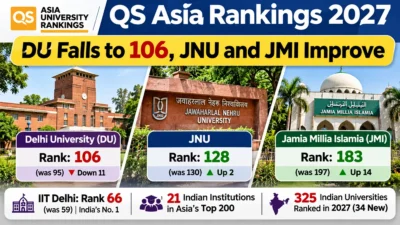
 NIRF #4 (2025)Jamia Millia IslamiaNew Delhi, DelhiAdmission: CUET UG, CUET PG, NET/JRFEst. 1920 · 239 acresView details
 NAAC A++
 NIRF #5 (2025)University of DelhiNew Delhi, DelhiAdmission: CUET UG, CUET PG, JEE MainEst. 1922View details
 NAAC A
 NIRF #6 (2025)Banaras Hindu UniversityVaranasi, Uttar PradeshAdmission: CUET UG, CUET PG, NET/JRFEst. 1916View details
 NAAC A+
 NIRF #10 (2025)Aligarh Muslim UniversityAligarh, Uttar PradeshAdmission: CUET UG, CUET PG, NET/JRFEst. 1920View details
 NAAC A
 NIRF #37 (2025)Babasaheb Bhimrao Ambedkar UniversityLucknow, Uttar PradeshAdmission: CUET UG, CUET PG, NET/JRFEst. 1996View detailsCUPNAAC A
 NIRF #77 (2025)Central University of PunjabBathinda, PunjabAdmission: CUET UG, CUET PG, NET/JRFEst. 2009View detailsCUTNNAAC A
 NIRF #83 (2025)Central University of Tamil NaduTiruvarur, Tamil NaduAdmission: CUET UG, CUET PG, NET/JRFEst. 2009View detailsCURAJNAAC A
 NIRF #89 (2025)Central University of RajasthanAjmer, RajasthanAdmission: CUET UG, CUET PG, NET/JRFEst. 2009View details
Background and Significance
The Integrated Teacher Education Programme (ITEP) is a four-year integrated degree launched in the 2023-24 academic session as part of the National Education Policy (NEP) 2020 reforms. Unlike the conventional route which requires a bachelor’s degree plus a two-year Bachelor of Education (B.Ed), ITEP integrates subject education and teacher training from Class 12 onward.
The NEP 2020 envisages the four-year integrated degree becoming the minimum qualification for school teachers by 2030. Yet, current recruitment rules and TET eligibility criteria do not list ITEP explicitly, preventing current and upcoming ITEP graduates from applying for teaching posts or appearing in these tests until amendments are notified.
Nearly 409 institutions have been authorised to offer ITEP with a combined intake capacity of 38,850 students across 777 units, indicating substantial scale and impact for future teacher recruitment.
Current Teacher Eligibility Qualifications
As of now, candidates eligible for CTET and STET exams typically hold qualifications such as:
- Two-year Diploma in Elementary Education (D.El.Ed)
- Four-year Bachelor of Elementary Education (B.El.Ed)
- Bachelor of Education (B.Ed)
- Four-year integrated B.A.Ed and B.Sc.Ed programmes
These qualifications, alongside passing the respective TET exams and other prescribed criteria, form the basis for recruitment to teaching positions.
The proposed amendments will formally add ITEP graduates to the recognized qualifications list, complementing existing teacher education programmes rather than replacing them.
Official links: Official notification